Written by Milly Phipps
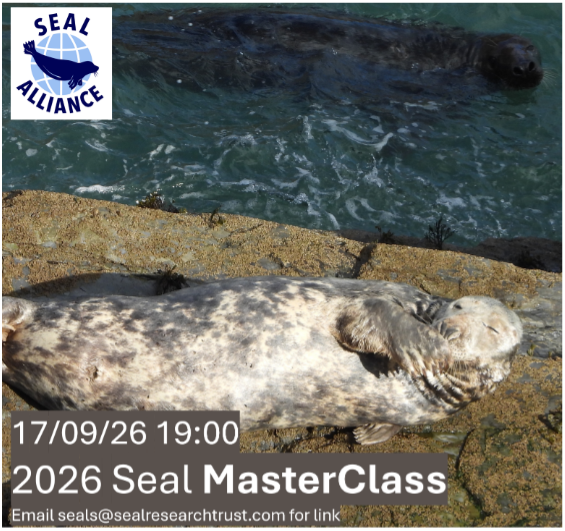
The 2026 Seal Alliance MasterClass was NOT one to miss… But if you did, don’t worry. Here’s a quick rundown of who presented, what their topics were, and why you should absolutely go and watch the recording which is up on our YouTube channel now: https://www.youtube.com/watch?v=v3LZ-de3jUg&t=1403s
Speaker and topic list:
SealMatch Photo ID software: Horace Lee (University of Oxford)
Social Solitary Seals: Dan Jarvis (BDMLR)
Give Seals Space campaign: Gareth Richards (Gower Seal Group)
Flying Rings campaign: Jenny Hobson (Friends of Horsey Seals)
Harbour Seal Skulls: John Arnott (Solent Seal Project)
How far away do seals need us to be?: Sue Sayer MBE (Seal Research Trust)
This was a highly anticipated evening, and my third attendance to the annual event. At least 120 people from all over the UK as well as from Mexico, Hawaii, France, Germany, Poland, Belgium, Cyprus and California were on the call!! Wowee!
SealMatch Photo ID software: Horace Lee (University of Oxford)
First up was Horace Lee, a Research Software Engineer from the Visual Geometry Department of the University of Oxford. Horace did an incredible job at absolutely blowing the minds of everyone on the call with the seal photo ID software: SealMatch.
After an introduction to photo ID, Horace spoke about the collaboration of SRT with Oxford University, walked us through a demonstration of SealMatch in use, addressed some problems with the software and potential solutions, and finished off with plans for the future of SealMatch!
SealMatch software, despite being incredible for seals, is adaptable to species and actually started its journey on chimpanzee identification. SealMatch is small part in the bigger picture that is AnimalMatch, a project that aims to incorporate the entire survey process into the software, as opposed to SealMatch that is primarily a search engine for the photo ID stage of processing. This software is already incredible, but it still has a long way to go. Horace and his colleague Dan Schofield are working hard to get the funding to continue the project. Thank you, Horace and Dan, for your tireless efforts on this project already, it is absolutely incredible and I have no doubt I am not the only one who is intrigued to see where it goes!
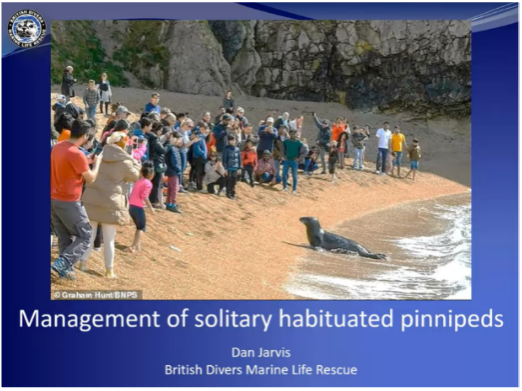
Social Solitary Seals: Dan Jarvis (BDMLR)
Next up was Dan Jarvis, the Director of Welfare and Conservation at British Divers Marine Life Rescue, who discussed his new concept of solitary habituated pinnipeds.
He began explaining this concept by first drawing our attention to solitary sociable cetaceans, which is a known concept of behaviours which are well categorised into habituation stages for cetaceans. Dan’s pinniped concept applies these well known stages seen in cetaceans, to seals. Listeners were taken through case studies of seals Bongo, Sammy, Violet and Spearmint/Wild Grey whose stories are all unique but have similar themes of habituation around humans, for example seen in heavily used areas by humans, hanging around for a prolonged period and more.
When it comes to defining the solitary habituated pinniped concept, a staging system for both the animal and human behaviour is currently used to evaluate the severity of the situation and create necessary management measures to ensure the safety of the seal and the public.
Dan’s presentation was insightful and thought provoking, to hear more about it, please do watch the recording on YouTube!
Give Seals Space campaign: Gareth Richards (Gower Seal Group)
Dan was followed by Gareth Richards, the chair of the Seal Alliance and from Gower Seal Group, who gave an incredibly important update on the Give Seals Space campaign. This campaign is vital to ensuring future safety for our native seal species.
The campaign petition page is massively informative, and well explained, so please follow the link below to read about WHY this petition is SO important!! Please do show your support by signing and SHARING the petition: https://www.change.org/p/give-seals-space ! At the time of writing this, we are at over 52,000 signatures!!!! Wooo hooo!
Flying Rings campaign: Jenny Hobson (Friends of Horsey Seals)
Jenny Hobson from Friends of Horsey Seals, discussed another incredibly important campaign: the Flying Rings campaign (read more, sign and share the campaign’s petition by following the link: https://www.change.org/p/stop-the-import-and-sale-of-flying-rings-that-cause-pain-suffering-and-death-to-seals ) and its impressive updates from 2026. The campaign took a leap forward by being supported by Gower’s MP Tonia Antonazzi who is incredibly proactive towards the campaign. A drop-in session on June 17th was organised and had 22 MPs and Lords attend and sign the Campaign Pledge! What a success! As well as this, the campaign has the support of 12 councils across the UK, and the petition has over 64,000 signatures.
Thank you so much to both Jenny and Gareth for their continued work hard towards these campaigns and for sharing these updates. You’re drive and passion towards these causes are evident, and seals couldn’t do it without you!! THANK YOU!!!
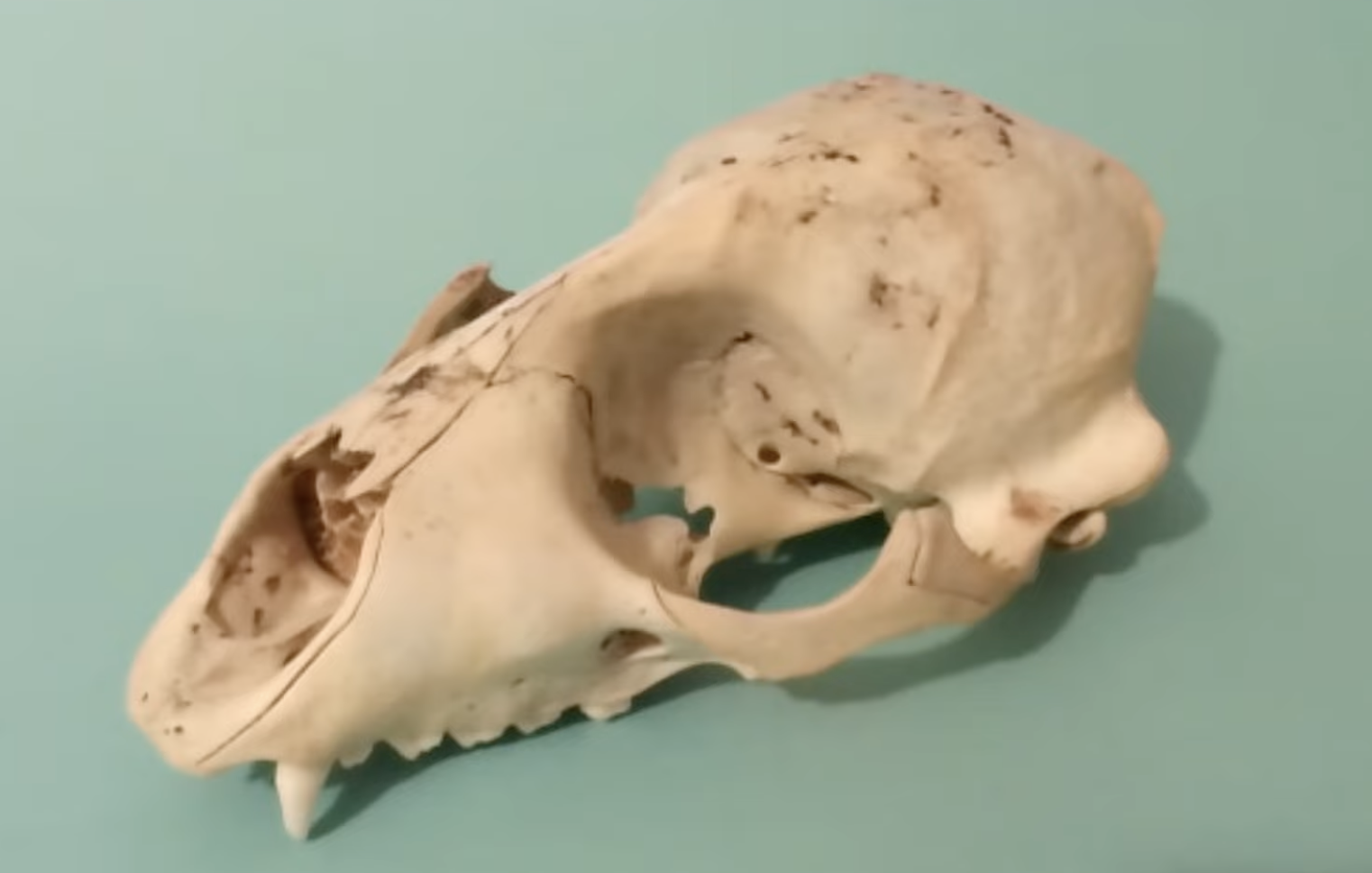
Harbour Seal Skulls: John Arnott (Solent Seal Project)
John Arnott followed Jenny, by conducting a part 2 to his talk during last year’s MasterClass! I won’t say much about this…. Other than go and watch it! His presentation starts at 01:01:55. Viewers were shown a harbour seal skull by John, where he focused in on a discussion of nostrils and the nasal turbinate bones. Dogs, cats and humans have these, but not as complex a level as seals do. Turbinates trap heat and moisture in the nasal cavity and avoid loss to the external environment. Thermoregulation is thought to be the main evolutionary driver for the development of these turbinates, and John clearly displays them through the skull shown on screen.
How completely epic! Thanks to John from the Solent Seal Project and Seal Alliance for your passion and expertise. Seriously go and watch this!
How far away do seals need us to be?: Sue Sayer MBE (Seal Research Trust)
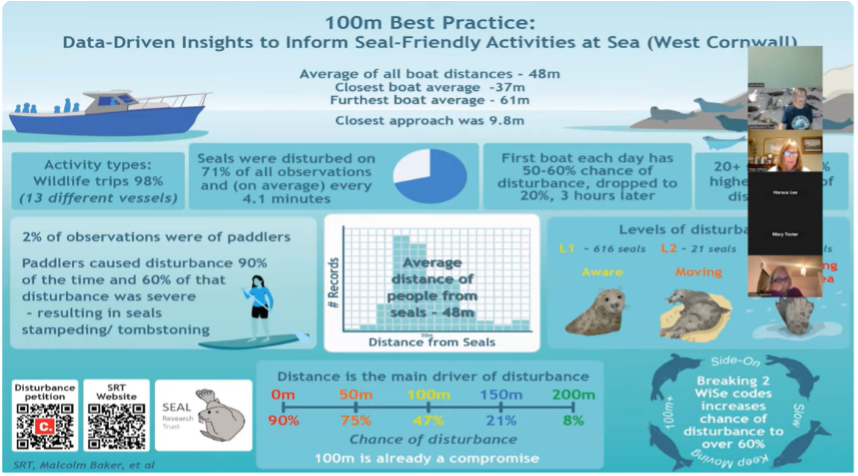
Sue Sayer MBE the founder and director of the Seal Research Trust, finished off the MasterClass by discussing how far away do seals REALLY do need us to be in order to be able to sleep effectively. A quick and BRIEF overview of the incredible research…
SRT’s People Protecting Precious Places project (2022 for DEFRA) found some shocking results in 2019 and 2021: people were present 65% of the surveys conducted for the project, causing disturbance 68% of the time. Overall tripper boats, RIBS and Air based vessels cause the most disturbance events overall, however paddle sports and swimmers cause the highest levels of disturbance. Seals were disturbed as frequently as every 18 minutes.
Following on from these revelations, several incredible actions occurred. A parliamentary drop in was organised by the Wildlife and Countryside Link to talk about making seal disturbance illegal and MP Andrew George made a presentation bill in parliament saying seals needed to be added to the Wildlife and Countryside Act 1981 under section 9 offences. In order to meet the criteria to be added to this Act, 1. Seals need to have international significance and 2. Disturbance needs to have a population level affect. SRT and Sue started digging deeper into the results of disturbance on seals. After hours of research, evidence was found of physical, visible effects such as injury and interrupted rest, as well as potential metabolic, hidden costs of disturbance on seals too. You can read SRT’s Blog about this too here: https://www.sealresearchtrust.com/news/the-unintentional-hidden-cost-we-are-having-on-seals
So, new research was undertaken in 2025 that dives deeper into the impacts of disturbance by Malcolm Baker, an SRT volunteer. It was found from 18 surveys at one location, that NONE of the vessels observed met the WiSe Scheme and DEFRA recommendation of staying 100m+ away from the seals (most were between 30 and 50m away) and this caused mainly level 1 disturbances (chronic disturbance level of being continuously woken up, looking around and stressed, likely resulting in hidden metabolic costs).
What this research shows is that even if boat operators follow best practice and remain 100+m away, there is STILL a 47% chance of the seals being disturbed. So 100m as a rule of best practice, is already a compromise to seals and their safety! Any closer than 100m, and disturbance chances are closer to 75%.
So a lot more was found from these incredible studies. Please do go and find out more detail in Sue’s talk from the MasterClass on YouTube!
This annual MasterClass never disappoints. Each and every speaker involved is so incredibly passionate, impressive and overall fantastic!
THANK YOU to SRT and Seal Alliance for another epic MasterClass, if you didn’t manage to catch it, its up on YouTube now! Hopefully see you next year!
Keep up to date with events and webinars happening via SRT’s Seals! Newsletter: https://seal-research-trust-news.kit.com/e4ab38a629