SealMatch: The AI Tool
SealMatch: The AI Tool Changing How We Track and Protect Grey Seals.
For over 25 years, Seal Research Trust (SRT) has been dedicated to understanding and protecting grey seals through one simple but powerful idea: every seal counts.
Since 2000, SRT has used photo-identification to study individual grey seals. Remarkably, five seals first identified that year were still alive in 2025 - living proof of the long-term value of this work. By recognising seals as individuals, we gain insights that go far beyond population counts, allowing us to understand their lives, movements, and survival in extraordinary detail.
Why Photo Identification Matters
Photo-identification (Photo ID) is a non-invasive, cost-effective, and highly accurate research method. By using each seal’s unique natural fur pattern markings, scars, and other features - we can track individuals throughout their entire lives without the invasive stress or risks associated with physical tagging.
Individual seal Photo ID enables long-term studies that provide critical data on:
Population dynamics
Site fidelity and movement patterns
Reproductive success (fecundity)
Philopatry (returning to birth sites)
Behaviour and social interactions
Wound development and health
Survival rates
These insights are essential for informing effective, evidence-based conservation strategies.
A Citizen Science Success Story
At the heart of SRT’s work is an extraordinary network of dedicated citizen science volunteers across the southwest UK. Together, SRT’s volunteers have already:
Conducted 67,000+ surveys
Processed 1.5 million photographs
Confirmed 154,000 seals identifications
This collective effort has revealed something surprising: grey seals are far more mobile than once thought. Seals first identified in Cornwall have been linked to:
The Isle of Man (450 km north west)
South West France (800 km south)
The Netherlands (650 km east)
North East England (1000 km north east)
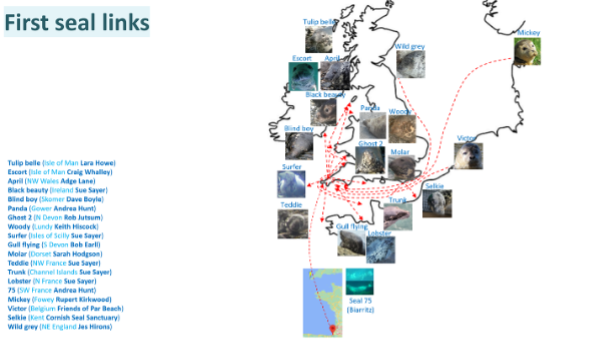
First seal links to Cornwall and other regions
These discoveries highlight a complex, interconnected use by seals of their marine environment. This requires equally sophisticated conservation approaches and understanding that can only be effectively delivered through individual seal Photo ID.
The Challenge: Scaling Up
Despite its success, traditional Photo ID has limitations. Manual identification relies heavily on human memory, visual pattern recognition and time-intensive workflows. Even with improved methods like keyword tagging, SRT’s process remains slow. For a small charity like SRT, which is run by just two full-time equivalent paid rangers with a Founder and Director Sue Sayer MBE volunteering full-time, this creates a significant challenge.
To fully realise the potential of their data, SRT needed a way to:
Speed up identification
Reduce missed matches (false negatives)
Connect catalogues across different regions of the UK
Make tools accessible to volunteers of all technical abilities
A Transformative Partnership
Enter Dan Schofield and Horace Lee from the Visual Geometry Group (VGG) at the University of Oxford. After previous attempts with other partners to develop bespoke software, this collaboration has proven to be a turning point. What sets this partnership apart is its truly collaborative approach - grounded in listening, understanding, and co-design. A key breakthrough came from a simple but powerful question from the VGG team: “Why search one catalogue, when you could search them all?” This insight reshaped the system architecture and unlocked new possibilities for SRT’s understanding of seal connectivity across regions. We appreciate there are more improvements needed, but Dan and Horace have the skills, knowledge, motivation and tools to make these possible.
The result is SealMatch software - a tool that is already transforming how SRT works. With SealMatch it takes a few seconds to save and upload a seal photo with a search time across 128,000+ photos of less than half a second!
SealMatch instantly generates a shortlist of potential matches, which volunteers can then confirm by eye. This combination of AI-powered efficiency and human expertise is proving incredibly powerful. SRT can search for a match using either seal photos or by using known tag words. Potentially matchable seals have multiple photos of each individual seal for SRT volunteers to compare to the unknown seal they are trying to ID, all of which increases the chances of success. New SealMatch features enable SRT volunteers to upload or update Photo ID catalogues in real time.
Real-World Impact
The software is already delivering impressive results:
Identifying seals from challenging angles, including belly patterns
Matching more seal individuals across different regional catalogues
Discovering even more previously unknown linked up sites
Supporting new volunteers to start to learn the seals more quickly on their patch
These moments of discovery are super inspiring for us all. A new ID match is scientifically valuable and always exciting for our volunteers. IDs are deeply motivating for our wonderful volunteers, who make this work possible. ID stories create emotional connections between seals and people, which hugely helps inspire advocacy within local communities.
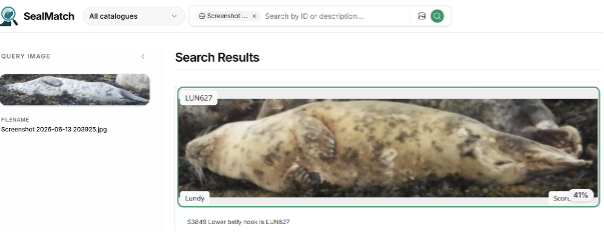
Seal identified from its belly pattern
Volunteers from other sites love finding matches to the West Cornwall catalogue. This seal (above) in North Devon was found in the West Cornwall catalogue by the SealMatch software, much to everyone's delight and surprise.
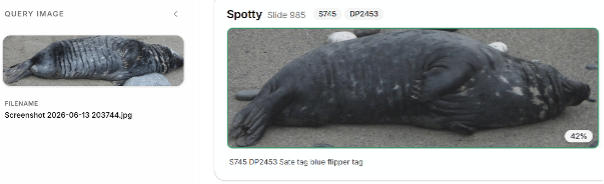
Recognising French ex satellite tagged seal ‘Sate’ from his belly pattern rather than the usual side on profile with which SRT catalogue holders are more familiar.
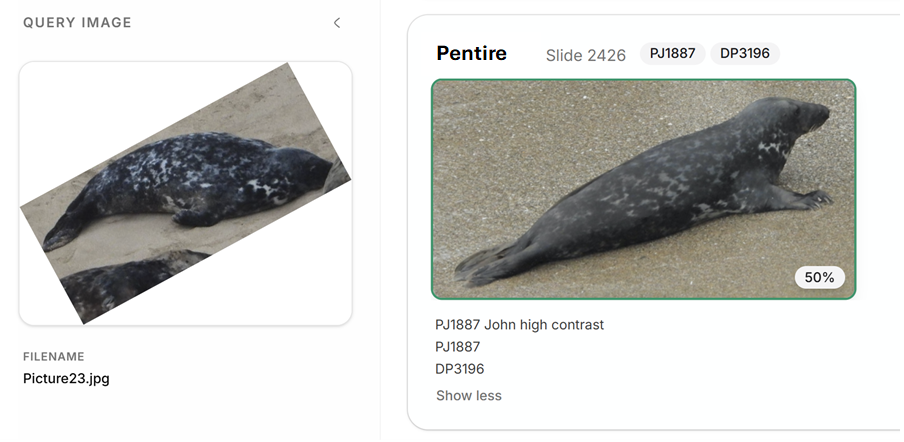
Finding a new match between the West Cornwall and Pentire Catalogues made us all smile!
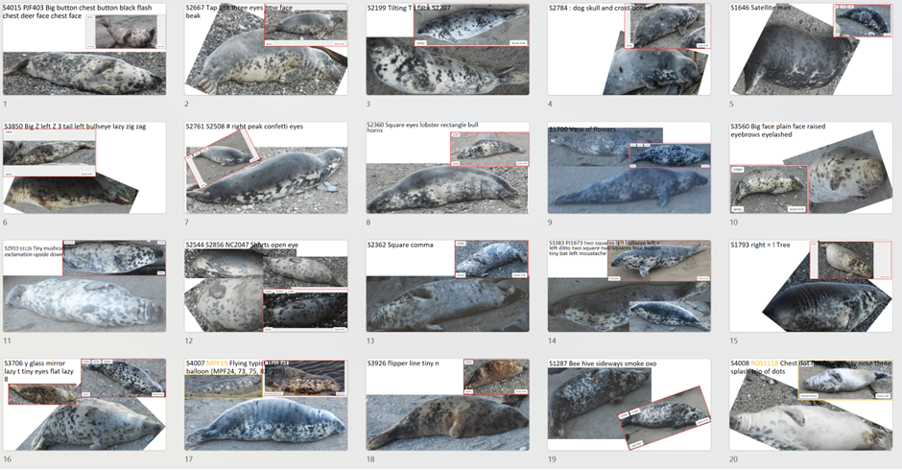
Example matches found with SealMatch (red border) and survey photos (no border)
Building Resilience for the Future
SealMatch is more than just a tool - it is a foundation for the future of SRT creating more efficiency going forward. By reducing workload and increasing accessibility, SRT can sustain and grow our incredible volunteer network, preserve and expand the knowledge we currently have, and ensure long-term resilience as our charity evolves.
A New Era for Seal Conservation
By combining SRT’s decades of citizen science expertise with cutting-edge AI, SRT and VGG are helping to push forward to a new era of marine conservation that is:
Individual seal based
Data rich with ever increasing numbers of seal identifications
Less dependent on human memory to remember seal fur patterns
Supportive and encouraging for new citizen scientists, helping them to get started with seal ID
Expandable across new areas beyond the southwest UK.
While the focus here is on speeding up seal photo-identification, this is just the beginning. VGG have some exciting new software apps in development, which we look forward to sharing in the near future as they evolve. SRT can’t wait to see the next steps and progress this project can make. Thank you all for making this possible.
Ultimately, this integrated approach will allow us all to understand more about our amazing seals, their habits, preferences and behaviours. This deeper dive into their life experiences will help better understand their needs whenever and wherever they are photographed - from land, sea, air, or underwater. This greater knowledge will enable us to better protect them more effectively than ever before.
This is, without doubt, the most exciting technological development in SRT’s history.