
Seal Match: The AI Tool Changing How We Track and Protect Grey Seals
The Seal Research Trust (SRT) have been Photo Identifying grey seals since 2000. In fact four of the seals first identified in 2000 were still alive in 2025! For SRT every seal counts and research at the individual seal level dives much deeper into their lives.
Seal photo identification is a crucial, non-invasive research tool because it allows scientists to track individual seals over their entire lifetimes using unique, permanent natural markings—such as fur patterns and scars, without any stress, cost, and physical risks associated with traditional tagging. Photo ID enables ongoing long term research studies that generate critical data on population dynamics, site fidelity, movement patterns, fecundity, philopatry, behaviour, wound development and survivorship, all of which are vital to support effective conservation efforts.
Prior to partnering with Dan Schofield and Horace Lee from the Visual Geometry Group (VGG) at Oxford University, SRT’s Citizen Science volunteers had been manually processing and recognising individual fur patterns. To date, SRT’s network across the SW UK had processed around 1.5 million photos from over 65,000 surveys resulting in over 150,000 seal IDs.
SRT know we need to move with the times and we love new software, but SRT are usually limited as a small charity by our lack of substantial funding (SRT only have 2 full time equivalent paid people in the charity - even the Founder and Director Sue Sayer MBE is a full time volunteer).
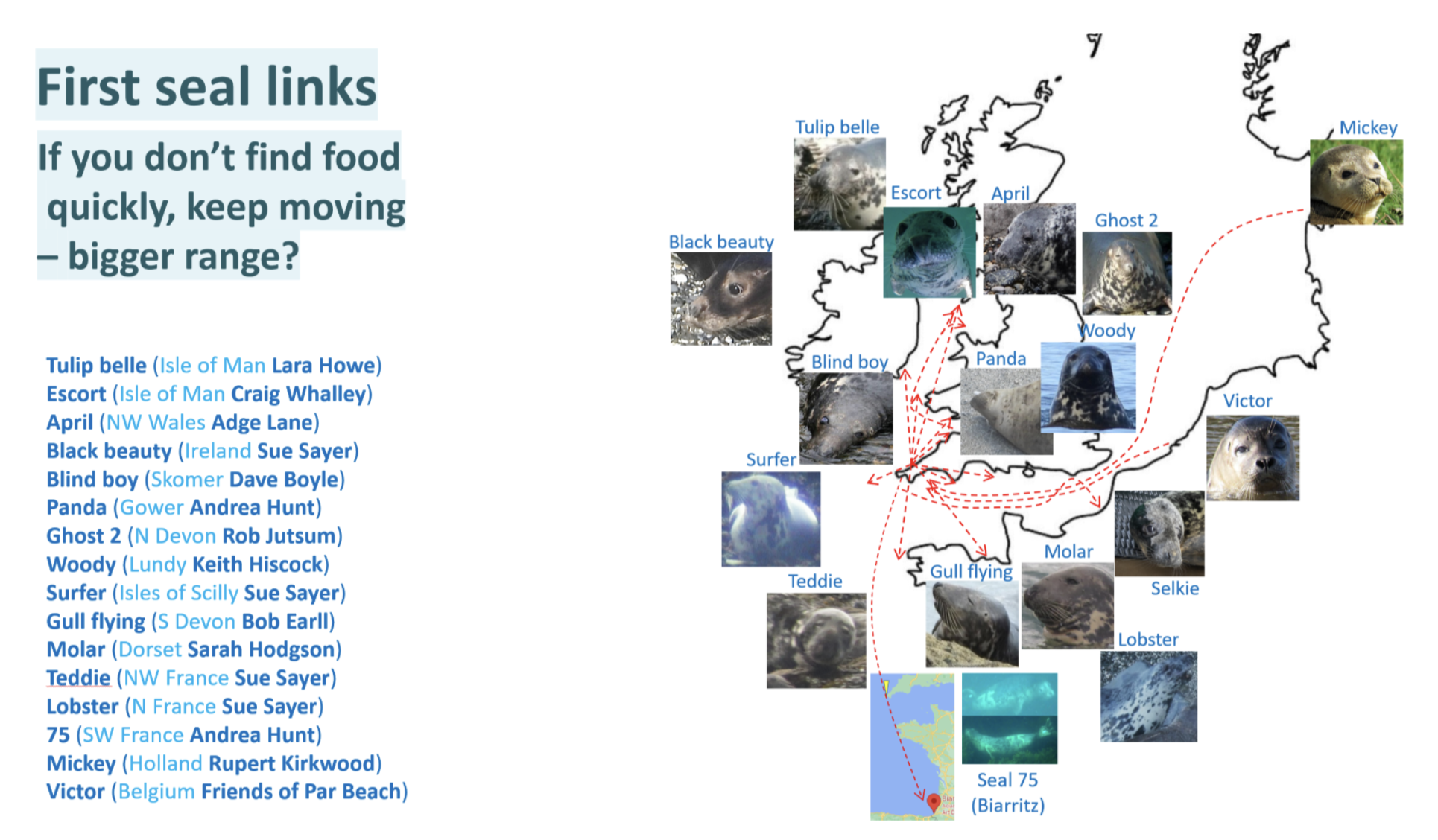
All SRT volunteers know we need help to speed up our manual ID system or even better integrate what we have learned from our manual ID techniques into AI software. This will help avoid false negative IDs (false positive IDs are rare) as well as enable more seal IDs across different site based catalogues building up a more complete and comprehensive picture of seal activity linked to the SW UK. To date, we have been surprised at the mobility of seals previously identified in Cornwall, with seal movements already linking to the Isle of Man (450km to the north); SW France (800km to the south); Holland (650km to the east) and NE England (1000km away).
We have previously had two unsuccessful attempts with University and Business partners to develop some bespoke Photo ID software that is user friendly (as not all our volunteers are super IT literate) and meets our needs. Dan and Horace have been inspirational and aspirational. Their positive 'can do' approach has been thorough, analytical and genuinely client focused. What we have been particularly impressed with is their willingness to work with potential collaborators which is quite refreshing compared to some past experiences we have had with researchers. Horace has been particularly good at asking questions to accurately understand our work processes in order to ensure outcomes are fit for purpose. For example, as a result of his questioning, we suddenly realised the importance of a fundamental change in the software structure....that when we submit a photo, it would be so much better to search all catalogues rather than just one. As a result we are all super excited and very keen to progress the Seal Match software to the next level with Dan and Horace.
Their aspiration hasn’t been limited to the Photo ID element of SRT’s survey process. Horace has aimed to create a suite of Apps that process SRT’s data from the survey all the way through to the database for analysis. As a result, they have created and built upon other invaluable apps. Seal Detector (originally created by Seb East from the University of Bristol) recognises seals and adds bounding boxes to survey photos speeding up processing time and enabling the relevant parts of survey photos to be cropped and inserted into survey album with speed and efficiency. Point Counter allows seals to be aged and sexed from stitched photos of the entire haul out of seals quickly and easily providing totals for seven different demographic metrics. These apps will be integrated into a holistic and integrated database architecture that will support SRT volunteers process independently verifiable photographic evidence as quickly, efficiently and accurately as possible.
This holistic and integrated database architecture isn’t just useful to SRT, but can be applied by other citizen science seal research groups and academics across the range of grey seals, especially where very large numbers of seals are present. It will also be applicable to SRT’s current partnership with Celtic Sea Power. as they develop their new underwater audio visual ‘Seal Spy’ kit that gathers data non-invasively about at sea seal foraging behaviour. Seal Spy has the potential to be deployed throughout the grey seal range, as well as be adapted for other seal and seal lion species across the world, as the offshore wind industry develops.
We appreciate there are a lot of improvements needed, but Dan and Horace have the skills, knowledge, motivation and tools to make these possible.
15 years ago it literally took 8 minutes to input a single photo into Photo ID software. Now it takes around 10 seconds to save and enter a photo into Seal Match and within less than half a second, the app has searched the 116,000+ photos to provide a shortlist of possible matches, which can then be confirmed manually by eye.
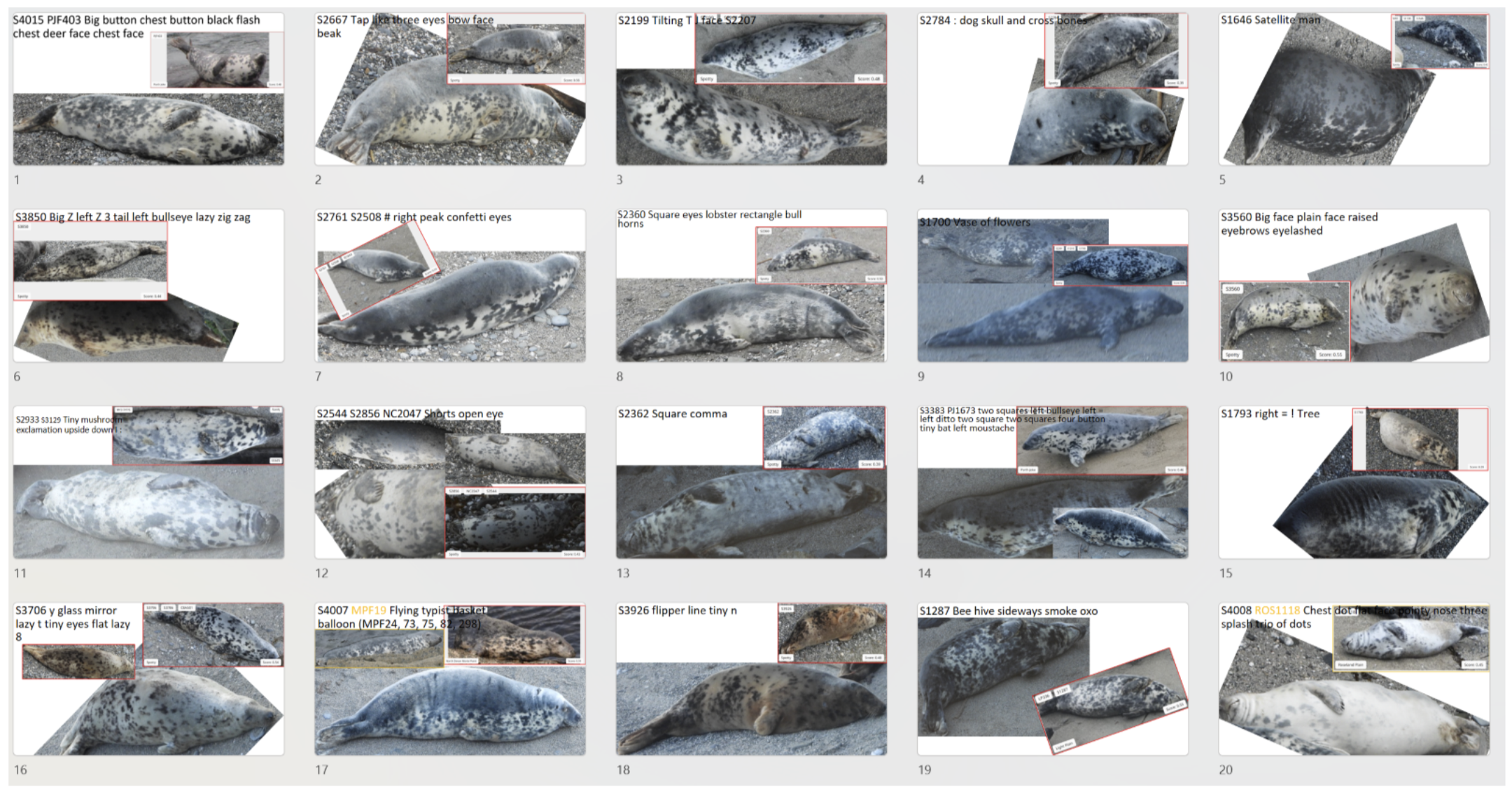
Example matches found with Seal Match (red border) and survey photos (no border)
The software too is super helpful to well established Photo ID Catalogue holders, but it is also a fantastic tool to help new Catalogue volunteers begin to learn seals in their catalogue, which helps hugely to inspire and motivate them. So this software tool will hopefully be key in maintaining SRT’s charity resilience for the future.
The VGG seal surveying database architecture can also support the Mammal Society’s current research priority 2025 to 2030 to replicate SRT’s citizen science surveying across the rest of the UK.
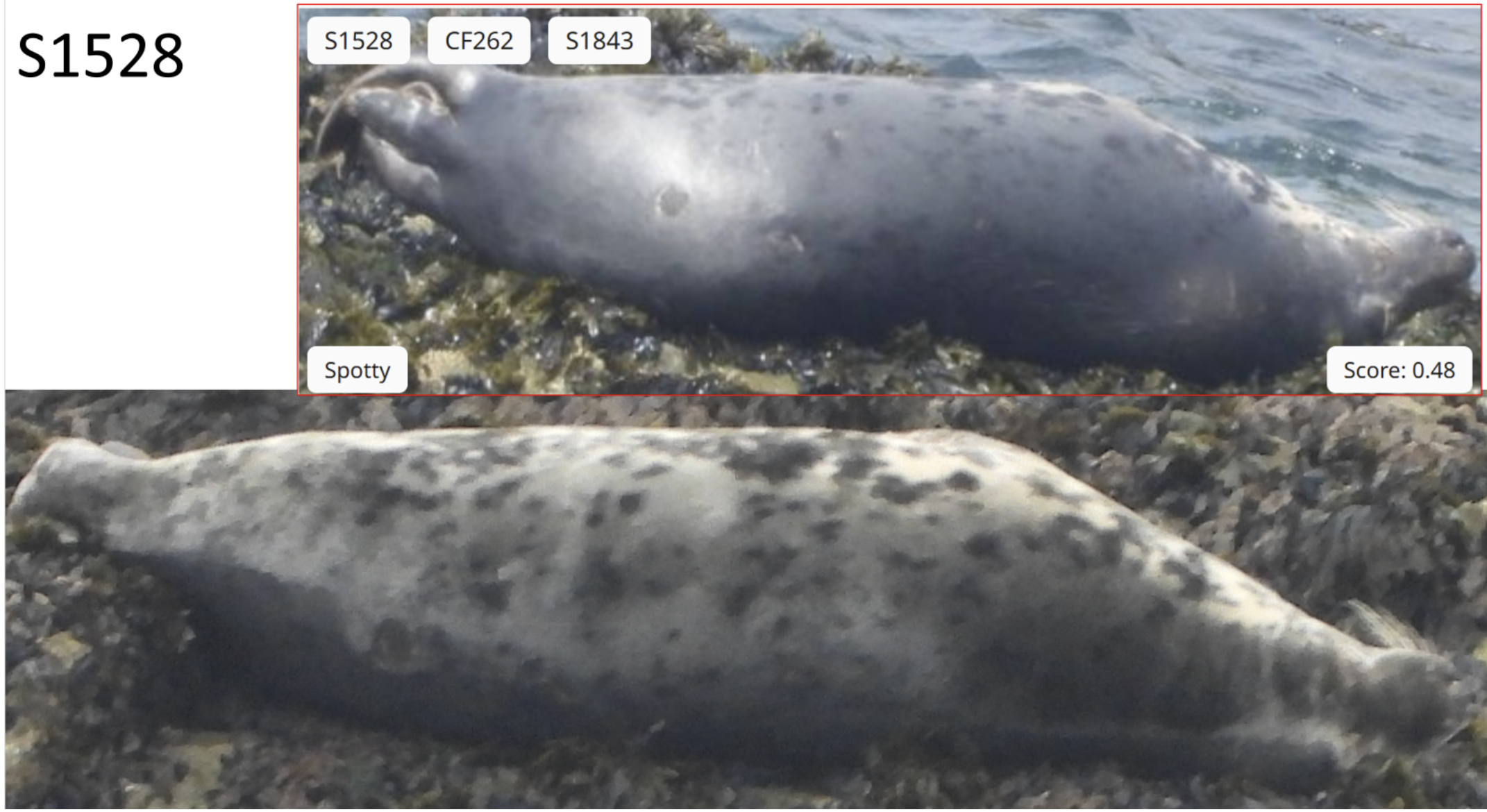
Finding a match of a first time ex rescue, rehab and released mum at a non catalogued location in a catalogue from a different site.

Recognising French ex satellite tagged seal ‘Sate’ from his belly pattern rather than the usual side on profile with which SRT catalogue holders are familiar.
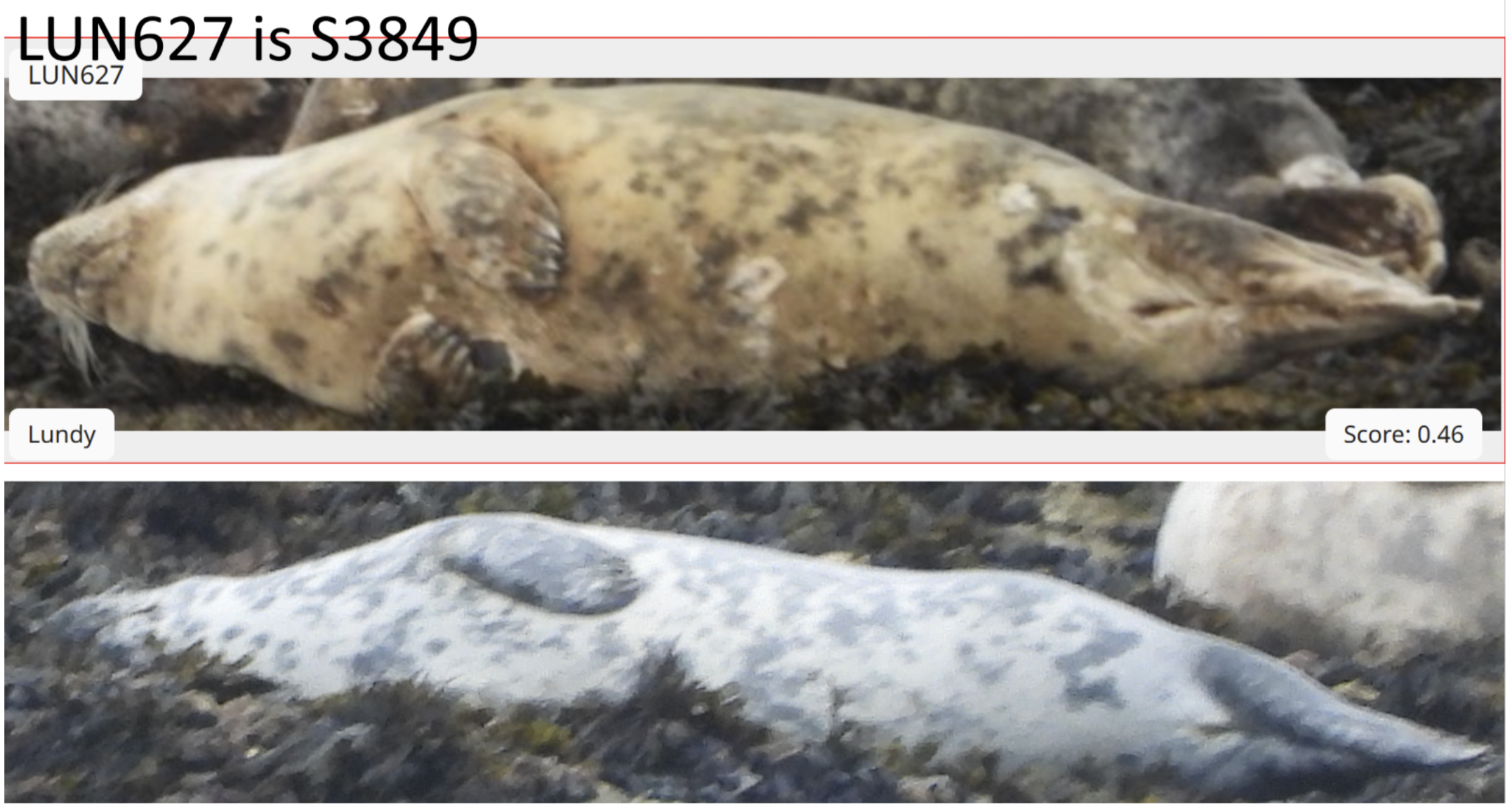
Volunteers from other sites love finding matches to the West Cornwall catalogue. This seal in North Devon was found in West Cornwall catalogue by the Seal Match software, much to everyone's delight and surprise.
The database apps are currently good and useful, but have so much potential to be amazing and with heaps of transferrable applications to other grey seal locations and potentially other species. This is the single most exciting IT project SRT have worked on in 25 years with the greatest potential to revolutionise long term automated seal Photo ID as a research method that is the most powerful of all research methods for seals. SRT can’t wait to see the next steps and progress this project can make. Thank you all for making this possible.
Ultimately VGG’s suite of Photo ID tools will enable seal research to reach the next level spatially and temporally, supporting all seal researchers to learn substantially more about our amazing seals at an individual level wherever they are encountered and photographed from land, sea, air and underwater.

Finding matches to seals that are in catalogues from two sites: West Cornwall and Pentire