Pups amaze, shock and upset
What a shocker this year has already been for mums and pups. This was exemplified by an extraordinarily heartbreaking experience for one of our volunteers, Martin Yelland. On a routine seal survey, it is always a delight to watch mums and pups and the highlight is inevitably watching a mum feeding a pup.
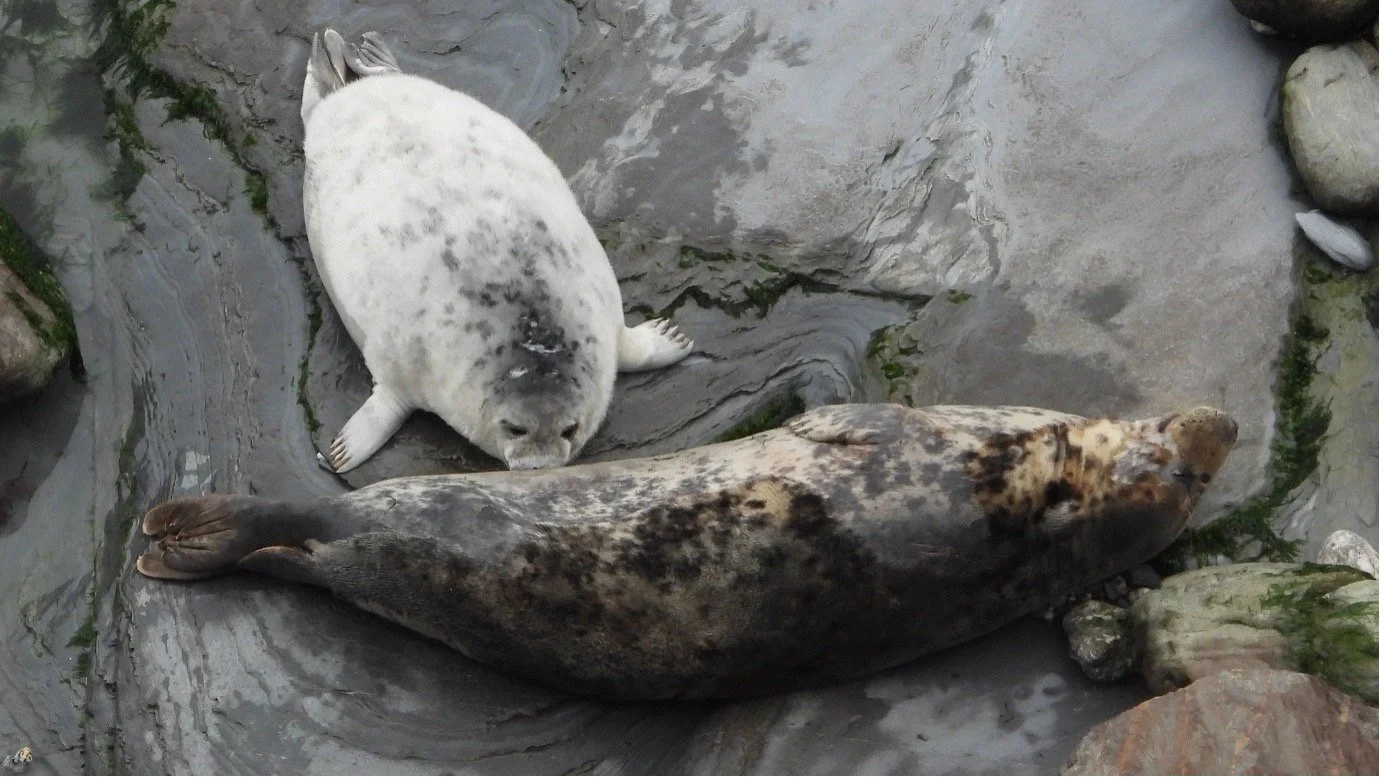
Mum ‘Round crab’ with her rather well fed 2026 pup. Photo by Sue Sayer
Expect the unexpected
Imagine Martin’s smile when as he saw a very healthy, fat white coat suckling from its mum – or so he thought. What happened next was totally unexpected. Martin suddenly noticed something strange happening at mum’s rear end. This gorgeous girlie ‘Tiny white back c’ was actually giving birth! How incredible that Martin was in the right place, at the right time, in the right conditions and with the right camera kit to record this extraordinary occurrence.
Delight to devastation
Often seal pup births are relatively quick, with just a few minutes between the pup becoming visible and then flopping out either head or rear flippers first (seals’ short limbs are less of an issue during birth than ours!) So, Martin was surprised when the pup’s rear flippers emerged and then stopped. Nothing much happened for around half and hour and then with a few big contractions the entire pup emerged. What a relief to see mum turn round to sniff her pup! Well it was until Martin realised that the pup was not moving. He waited and waited and slowly sadness overcame him as it became clear that the pup was stillborn.
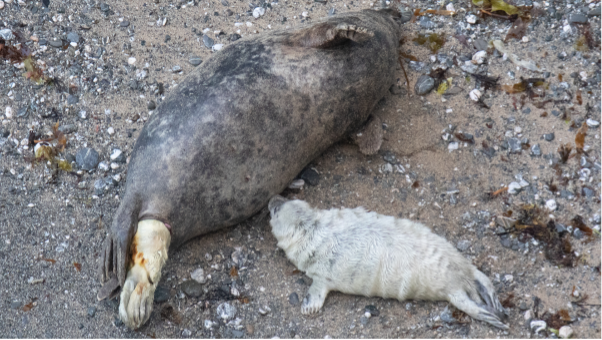
Mum ‘White back c’ feeding pup whilst giving birth to a stillborn pup. Photo by Martin Yelland
And it gets worse
Thank goodness Martin had taken ongoing photos of the whole experience. Back in the office we were able to review them, timelapse style. We think the pup was likely alive during the early stages of the birth, as its rear flippers were moving initially. Perhaps the prolonged time the birth took resulted in the pup dying as its flippers suddenly visibly flopped with no subsequent flexing. Devasting for the pup, mum, Martin and the rest of us.
How to help any seal pup that you see
Always give seals space (ideally 100m+ wherever possible). This is especially important if you see a maternally dependent, white coated seal pup. Stay out of sight in case mum is resting in the sea. If you are concerned, because you can’t see a mum or the pup is very thin and potentially injured, then please call British Divers Marine Life Rescue (BDMLR) 01825 765546. Please also sign and share our Give Seals Space petition: https://www.change.org/p/give-seals-space .
Amazing adaptation
This resulted in so much wasted time, effort and energy, as the pup would have been conceived 12 months earlier. Grey seal gestation is around eight months, as mums delay the implantation of their fertilized egg for up to three months. Mums mate as they wean their pups at two to three weeks. At this time they have transferred up to 80% of their fat reserves to their pups, so they are near starving. They have to feed and fatten up before they can implant their fertilized egg and grow it. This delayed implantation is called embryonic diapause and other UK mammal species can do this including badgers, stoats, weasels, pine martins, otters and roe deer – all controlled by environmental conditions. Embryonic diapause enables mums to pup on an annual cycle and give birth at a time in the year that gives the pup the best chance of survival.
Why do seals pup when they do?
It seems strange for grey seals to pup between August and January across the UK, when weather and sea conditions can be at their worst, with big spring tides and storms. Nature is rarely simple and so we speculate that the timing of pupping is actually related to prey availability. Pups suckle for two to three weeks, becoming fat healthy chonks. They spend the next couple of months living off their own fat reserves. By the time these become depleted, sandeel spawning occurs creating a proliferation of their favourite food, helping pups to learn how and what to catch enabling them to feed more easily.
2026 an extraordinary year
As we write, SRT have recorded white coated pups in every single calendar month of this year. Historically white coated pups have been recorded across all months over a decade, but never in a single year. Of the 12 pups SRT logged from January to July, 11 had no mother and so were doomed. Despite our best efforts, in partnership with British Divers Marine Life Rescue, we have been unable to help these pups survive. It is simply not possible to rescue all pups, especially those on inaccessible beaches risking human safety; where there are other mums and pups to potentially put in danger of abandonment and where there are large numbers of other seals who would likely injure themselves when stampeding into the sea. In these cases, all we can do is give these poor pups a voice and tell their stories.
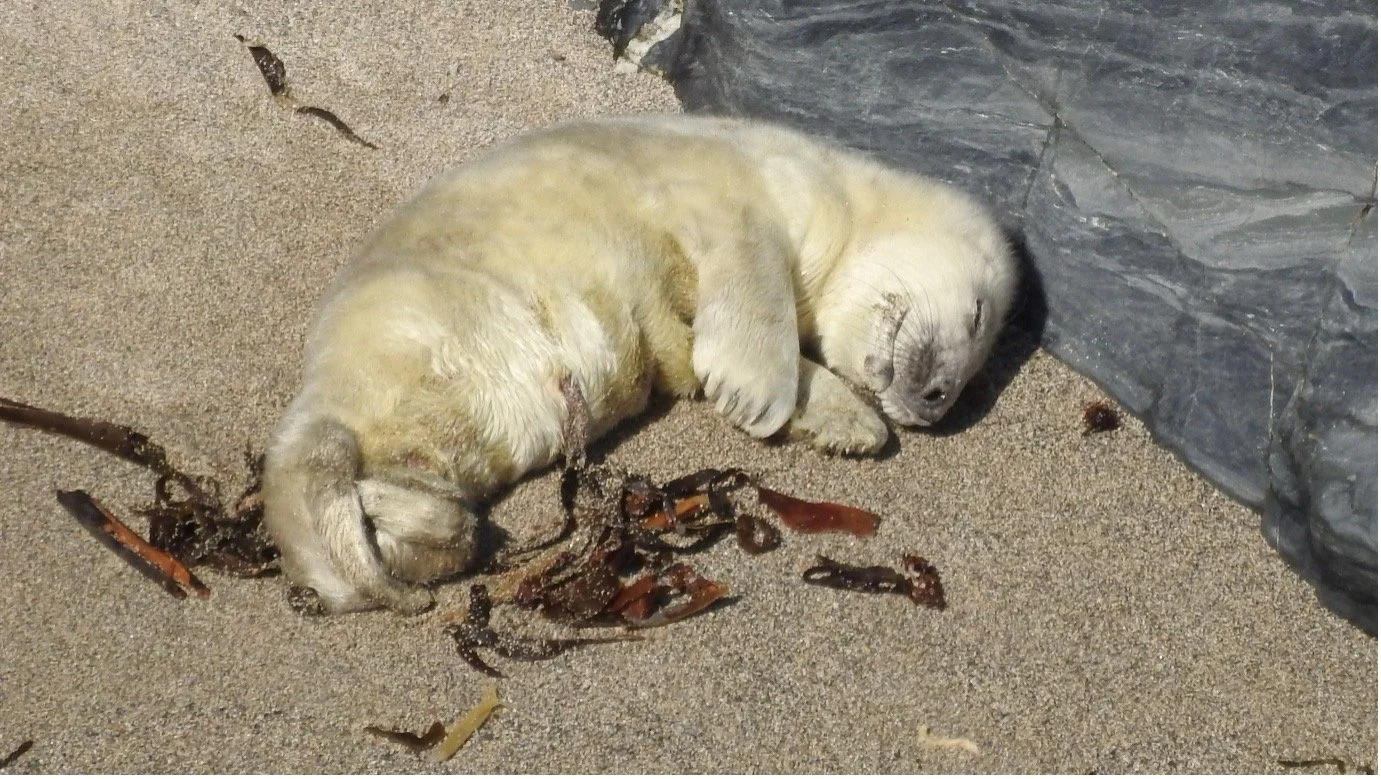
Out of season pup with no mother that was rescued by BDMLR and sadly euthanased. Photo by Florence Hall
Pup monitoring rotas
SRT routinely set up and share ‘pup monitoring rotas’ for pups we are concerned about. Whilst challenging for volunteers to witness, the data they collect is totally invaluable. To date, we have two examples of where pups have survived a shocking five days without ever having been fed milk by their mothers. Pups struggle so very hard to survive, wandering everywhere in search of their mums and trying to suckle from other seals, some of whom are tolerant, whilst others are less so. From our amazing volunteers we have learned that day four is desperation day. Day four is when pups get highly active in a final, desperate attempt to survive, even swimming energetically out to sea in search of mum and sustenance, before their collapse into unresponsiveness on day five. Desperation day four can easily be misinterpreted by observers thinking the pup is active and healthy with a mum just out of sight or in the sea.
We do also learn important new data. From three pup watches SRT have learned that on average mums feed their pups for an average of 8.5 minutes throughout their lactation. Whist this is a small sample, all pup watches varied hugely so we were shocked when the average feed time turned out to be exactly the same!
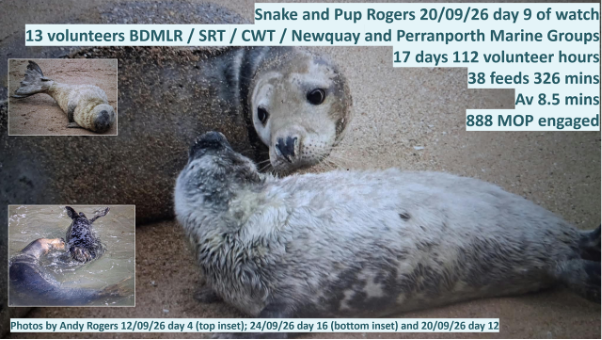
2026 Pentire pup watch rota achievements and outcomes to give this pup a great start in life and its best chance of survival. Photos by Andy Rogers
Seasons out of sync?
Add to this, SRT records show we have a substantially earlier pupping season than a decade ago. Up to 2016, most pups were born in October followed by November. Since then, pupping season has moved earlier and in the last four years, most pups have been born in September followed by August. Of the first 100 pups born up to the end of August 2026 in Cornwall between 40 and 53% have been dead or dying without a mother. Historically, the JNCC reported pup mortality in their first three weeks was around 15%. So, in comparison this years mortality for pre weaned pups is extremely worrying and a red flag to conservation and statutory agencies.
So why is this so worrying?
It is tempting to think that if pup numbers are stable or increasing that everything is OK with seals. Nature is not that simple. Population size is a combination of inputs (births and immigration) and outputs (deaths and emigration). The best analogy is to think of a bath. The height of the bathwater is controlled by the input via the two taps and output via the plug and the overflow. Population size cannot be assessed using just one of these metrics, but can only be assessed and understood with information on all four. Having accurate data on deaths is vital as well as understanding what is happening with movements (which can only be informed by Photo ID or satellite tracking). In short, it is very complicated. Nothing can be assumed about population size from simple pupping data and it gets even more complicated!
Increased pupping isn’t always good sign
Populations under pressure can increase fecundity (reproductivity) as an evolutionary survival strategy to offset high risks of death. When mortality is high, individuals experience pressure. As a result, they produce more offspring ensuring that at least some will survive to adulthood, when the chance of individual survival is low. Whilst the chance of seals producing twins is extremely low, this was recorded in Cornwall in 2025 for only the second time ever in the wild. Mums can increase their fecundity by having a pup every year rather than missing years. As a result, increasing pupping can actually be an indicator that something is seriously wrong with multiple stressors affecting the population.
What do we know about deaths?
Coming back to 2026, not only have SRT already observed very high numbers of pups without mums or dead, but Cornwall Wildlife Trust Marine Strandings Network (CWTMSN) have also had an unusually high number of pup deaths. In addition, in the first 21 days of September, CWTMSN’s amazing volunteers have recorded at least nine dead adult females either pregnant or lactating. This is unusual and worrying. When pups die this affects population recruitment that will result in fewer pups in six years time (how long it takes a seal pup to reach sexual maturity). When adult females die it affects pupping more immediately, with fewer pups likely next year. Even more surprisingly, SRT has been able to ID five of these dead adult females. SRT usually ID around three to five of all the dead 150 to 300+ seals in a year in the last decade, so to ID five adult females in just one month is unheard of.
Saying goodbye to our gorgeous girlies
‘Person opening a box’ was first ID’d in 2017. She has been ID’d 95 times by 27 different volunteers at five different locations across three different areas between West Cornwall and Pentire. Her last live sighting was on 27/04/26 and she was found dead on 08/09/26 likely around 14 years old.
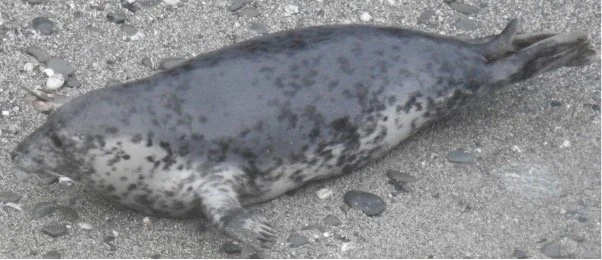
Archive photo of ‘Person opening a box’. Photo by Sue Sayer
‘Beak left comma’ was first ID’d in 2015. She has been ID’d 91 times by 19 different volunteers at four different locations across two different areas between West Cornwall and Pentire. Her last live sighting was on 17/03/26 and she was found dead on 09/09/26 likely around 16 years old.
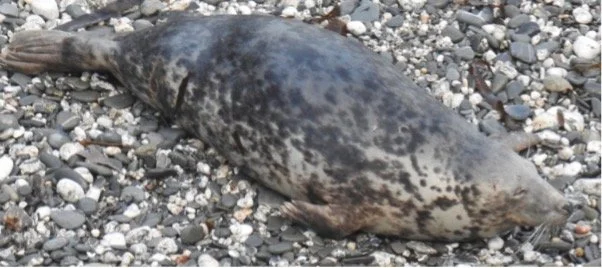
Archive photo of ‘Beak left comma’. Photo taken by Sue Sayer
‘Big X wobbly t cross’ was first ID’d in 2016. She has been ID’d 50 times by 24 different volunteers at four different locations across two different areas between West Cornwall and North Cornwall. Her last live sighting was on 27/05/26 and she was found dead on 15/09/26 likely around 17 years old.
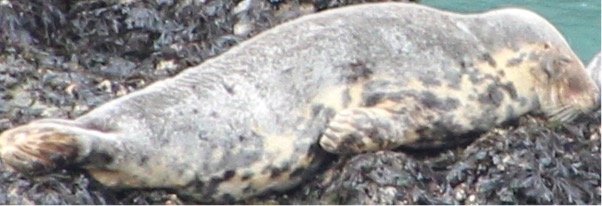
Archive photo of ‘Big wobbly t cross’. Photo by Sue Sayer
‘Tie t scream’ was first ID’d in 2002. She has been ID’d 68 times by 22 different volunteers at seven different locations across four different areas between West Cornwall and Trevose. Her last live sighting was on 11/02/26 and she was found dead on 16/09/26 likely around 29 years old.
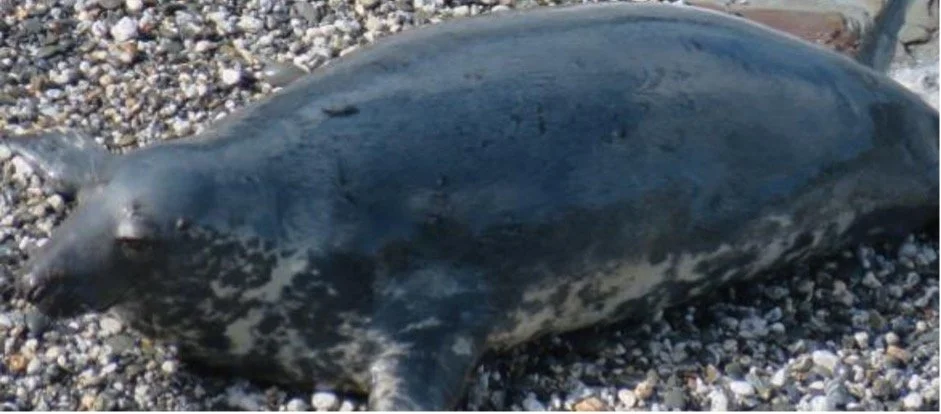
Archive photo of ‘Tie t scream’. Photo by Sue Sayer
‘Cat’s whiskers’ was first ID’d in 2012. She has been ID’d 64 times by 15 different volunteers at seven different locations across four different areas between West Penwith North and Porthtowan. Her last live sighting was on 25/06/26 and she was found dead on 17/09/26 likely around 18 years old.
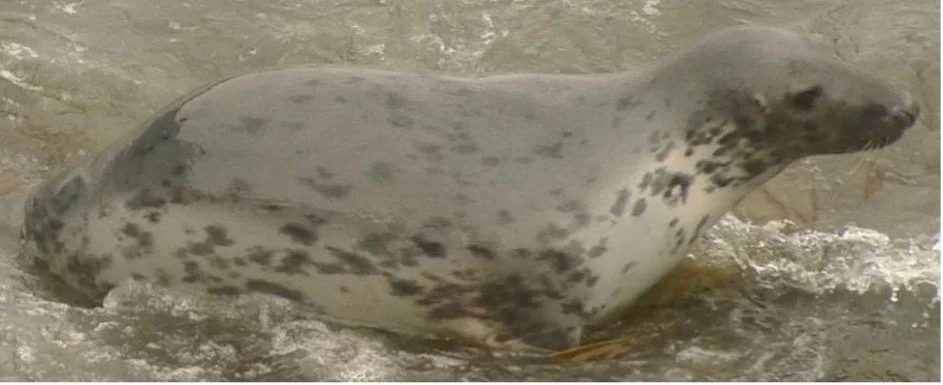
Archive photo of ‘Cat’s whiskers’. Photo by Sue Sayer
Out of these five dead seal IDs, only one appears to have reached the average life expectancy for an adult female grey seal….another red flag of concern.
What to do if you see a dead seal
We are lucky in Cornwall that CWTMSN volunteers have been recording dead seals since 2000. Despite its name, the Cetacean Strandings Investigation Programme (CSIP) began recording dead seals across the rest of England and Wales in 2021, so we are still raising awareness of this.
If you see a dead seal anywhere around the UK, it is vital to get this recorded. Please don’t hesitate to ring 0800 652 0333 to report a dead marine mammal anywhere across the UK and alert others about the importance of doing so.
In summary
Cornwall’s current pupping season has been extraordinary.
Pupping seasons can be very challenging for our volunteers to witness the trials and tribulations that our grey seals experience.
Grey seal mums perform embryonic diapause to survive.
Seals mums give birth at the time of year that is best to ensure their pups have enough food to survive their first year.
Pupping season has moved around three months earlier since 2022.
SRT and partner organisations such as BDMLR and CWT set up pup monitoring rotas when mums have their pups on publicly accessible beaches.
Increased pup numbers might not be a good thing – what matters is how many survive their first year.
Pup mortality in Cornwall is surprisingly and worryingly high
We have had to say ‘goodbye’ to five gorgeous adult females this month.
Please always report dead seals to CWTMSN 0345 201 2626 in Cornwall and CSIP by ringing 0800 652 0333 across the rest of the UK.
Please help us continue this vitally important research and Photo ID work by considering a donation you can afford however small, joining our Wild Seal Supporter and Adoption Scheme for £3.50 a month, running a fundraising event or leaving a gift for seals in your will. Thank you from seals everywhere!